
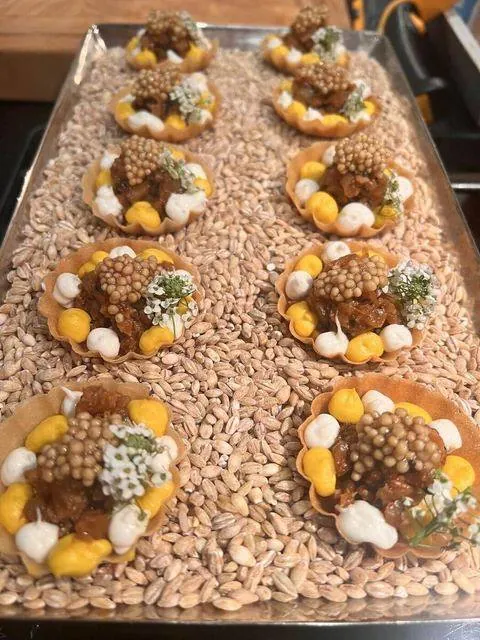
A walking dinner is a multi-course meal served in small portions in stages while guests stand, mingle and move between rooms or stations rather than sitting at one table. It combines the feel of a dinner with the energy of a reception, and suits 20 to 100 guests at home, in venues and at company events.
Alejandro Nicolau, a London private chef trained under Martin Berasategui, plans walking dinners for private parties and corporate events. This guide explains how the format works, what it needs and when it is the right choice.
01What is a walking dinner?
A walking dinner, sometimes called a standing dinner or a progressive dinner, is a meal of several small courses served in stages. Guests eat standing or perched, move around the space and meet different people between courses.
It sits between a canapé reception and a seated dinner. Unlike canapés, the dishes are composed and served as courses; unlike a seated dinner, no one is tied to a seat or a neighbour.
02How does a walking dinner work?
- Guests arrive and receive a welcome drink.
- A first small dish is served, often a cold starter or soup in a cup.
- Further courses follow every 15 to 20 minutes, building from light to rich.
- A dessert course or table closes the meal.
- Coffee, petit fours and drinks continue as the party opens up.
Service can be by tray, from stations or a mix. The chef sets the pace so that guests always have something to eat without being rushed.
03How many courses should a walking dinner have?
Four to six courses is usual, each a few mouthfuls. Fewer than four feels like a canapé party; more than six can feel long for guests who are standing.
- Four courses: a cold starter, a warm dish, a main-style dish and a dessert. Good for a two-hour party.
- Five or six courses: add a fish course and a palate-cleansing dish. Better for a three-hour evening.
Seasonal ingredients make the menu feel connected. A winter walking dinner might run from a roasted squash soup to a slow-cooked beef dish and a citrus dessert.
04What food works best for a walking dinner?
The test is simple: can a guest eat it with one hand, or with a fork, while holding a drink? If it needs a knife or a table, it does not belong.
- Cups and bowls: soups, risotto, ceviche or a small rice dish served in a ceramic spoon, cup or small bowl.
- Small composed plates: a single scallop, a lamb cutlet portion or a vegetable dish designed for a fork.
- Hand-held pieces: small tacos, mini burgers or filled breads for lighter moments.
- Dessert in one: a tart, a mousse in a glass or a mini pastry.
See canapé catering and buffet catering for the formats on either side of a walking dinner.
05What space and staff do you need?
The room matters more than for any other format. Guests need to stand comfortably, reach somewhere to put a glass and move without queuing.
- Allow roughly 1 to 1.5 square metres of standing space per guest, more if there are stations.
- Provide high tables or ledges so guests can rest plates and glasses.
- Plan a clear service route for staff that does not cross the busiest area.
- Plan more staff than for a seated dinner: trays, clearing and drinks all need hands.
A chef-led team will walk the space beforehand, or look at photos and a plan, and recommend the number of staff and stations.
06When is a walking dinner the right choice?
- Company parties and launches where mingling is the point. See corporate catering.
- Milestone birthdays and house parties with 20 to 60 guests and a home that does not seat everyone.
- Weddings and receptions as the first stage before a seated meal.
- Networking events where seating would limit conversation.
It is less suitable when guests are older, have mobility needs or when you want formal speeches and long conversations over the table. In those cases a seated dinner works better.
07What does a walking dinner menu look like?
Here is a five-course example for a winter evening, to show how the pacing builds.
- Arrival: a welcome drink and a warm croqueta or small tartlet.
- First course: roasted squash velouté in a small cup.
- Second course: cured fish on a small plate with citrus and herbs.
- Third course: slow-cooked beef cheek with potato purée, eaten with a fork.
- Dessert: a chocolate and orange pot, with coffee and petit fours to follow.
Each course is a few mouthfuls. The goal is that guests leave feeling they have eaten a proper meal, without ever having sat down.
08What are the common mistakes at a walking dinner?
A walking dinner looks relaxed, but it relies on careful planning. These are the mistakes that most often spoil it.
- Dishes that need a knife. If it cannot be eaten with a fork or a spoon, it will frustrate guests.
- Too long between courses. A gap of more than 25 minutes breaks the rhythm and leaves guests hungry.
- Not enough surfaces. Guests holding a plate and a glass cannot eat; give them somewhere to put one down.
- Too few staff. Trays and clearing need hands, and waiting guests lose patience quickly.
- No plan for dietary needs. Each course needs a vegetarian or allergy-friendly version ready to serve.
Walk through the evening with the chef beforehand and check each point against your space. Most of these problems are easy to fix on paper and impossible to fix mid-party.
09How do you plan a walking dinner?
- Fix the guest number and the length of the party.
- Choose four to six courses and the service style: trays, stations or both.
- Check the space for standing room, surfaces and staff routes.
- Share dietary needs early.
- Agree timings with the chef, including when each course is served.
Send your plan through the enquiry form and the team will reply within 24 hours with a menu and staffing proposal.
Planning an event and want the food and drinks taken care of? Send the date, guest count and any requirements through the enquiry form and the team will reply within 24 hours.
Plan Your EventExplore: canapé catering, buffet and walking dinner catering, private chef for house parties.