
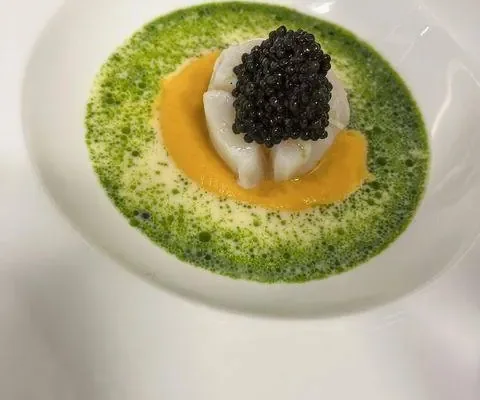
How to serve caviar at home comes down to temperature and restraint: keep the tin well chilled on crushed ice, use a mother-of-pearl, horn or glass spoon, and allow about 30 grams per person as a tasting portion or 5 to 10 grams per canapé. Pair it with something plain and rich, such as blinis, crème fraîche or warm potato, and a dry champagne. Open the tin only when guests are ready.
Alejandro Nicolau, a London private chef trained under Martin Berasategui, and his team use caviar in canapés, starters and tasting menus for private dinners. This guide explains how to buy, chill, serve and pair it so it tastes exactly as it should.
01How to serve caviar at home: the basics
Caviar is the salted roe of sturgeon, and it is at its best when it is cold, unhandled and served with nothing that competes with it. The ritual is simple, and most of what makes the experience feel special is simply care.
- Keep it refrigerated until the moment of serving, ideally around 0 to 4 degrees.
- Set the tin on crushed ice in a bowl, so it stays cold at the table.
- Open it just before serving, and take it out of the fridge only when guests are ready.
- Use a non-reactive spoon, such as mother-of-pearl, horn, bone or glass.
- Serve straight away and finish the tin the same evening where possible.
02What are the main types of caviar?
Names vary by producer, but you will most often see these.
- Oscietra (Osetra): medium grains with a nutty, slightly briny flavour.
- Siberian: a clean, balanced caviar and a common choice for private dinners.
- Beluga: large, soft grains and a delicate, buttery flavour, usually the most sought after.
- Kaluga: large grains with a rich, creamy taste.
Whichever you choose, ask where it comes from and how it was farmed or sourced, since provenance and freshness matter more than the name on the tin.
03How much caviar do you need per guest?
- As a tasting portion: about 30 grams per person, served on its own with a small accompaniment.
- As a starter ingredient: 10 to 15 grams per person, used to finish a dish such as scallop or a tartare.
- On a canapé: 5 to 10 grams for each piece.
For a generous canapé reception, see how many canapés per person to plan the overall quantities, then decide how much of the menu to dedicate to caviar.
04What should you serve with caviar?
The goal is to give it a neutral, rich base that does not hide the flavour.
- Blinis or toast points: warm, small and lightly buttered.
- Crème fraîche or soured cream: a cool, lightly acidic contrast.
- Soft egg: chopped egg yolk or a lightly set egg adds richness.
- Warm new potatoes: a classic, simple base.
- Raw or lightly cooked shellfish: scallop or oyster work beautifully.
Skip strong flavours such as raw onion, lemon in quantity and heavy sauces, which overpower the roe.
05What should you drink with caviar?
Dry, high-acidity drinks cut through the richness without masking it. Champagne, especially a brut or extra brut, is the classic partner. Other good choices are a crisp, mineral white wine, a dry sparkling wine or very cold vodka served in small measures.
For guests who do not drink alcohol, a chilled sparkling tea or a dry, lightly sparkling alcohol-free drink works well. See wine and menu pairing for a private dinner for matching drinks to the whole menu.
06How do you use caviar in a menu?
A chef rarely serves caviar on its own for a whole meal. It works best as a precise finishing touch on a dish where the main ingredient is already excellent.
- On seared scallop with a herb sauce or a light purée.
- On a canapé of cured ham, tartare or a delicate tartlet.
- With oysters as a cold, briny starter.
- As a small course within a tasting menu, served in a tiny portion.
See how tasting menus are designed from scratch for how a course like this fits into the rest of the evening.
07What are the most common mistakes?
- Letting the tin warm up on the table.
- Using a metal spoon that can alter the flavour.
- Buying more than guests can enjoy, which wastes an expensive ingredient.
- Adding too many strong accompaniments.
- Opening the tin too early and leaving it out.
- Serving it with a heavy meal that has already dulled the palate.
Smaller, better and colder is nearly always the right answer.
08How do you store caviar before serving?
Caviar is a delicate, perishable ingredient, and how you keep it matters as much as which one you buy. Store it in the coldest part of the refrigerator, not in the door, and keep the tin sealed until you serve it.
- Buy as close to the day as possible and ask the supplier for the date.
- Keep the tin flat and never freeze it, which damages the texture of the grains.
- Take it out only when guests are ready to eat.
- Serve it from a bowl of crushed ice so it stays cold throughout.
Follow the guidance on the tin from the producer. If anything smells unpleasant or looks dull, do not serve it.
09How should you present caviar at the table?
Presentation is simple and gives the moment its sense of occasion. Spoon a small mound onto a cold plate or serve it in the tin set into ice, with one spoon for the caviar and small plates for each guest.
Let guests help themselves to a modest portion, and place the accompaniments alongside rather than on top. A chef will often serve the first portion at the table, so the host can sit down with their guests rather than manage the tin.
10When should you bring in a private chef for caviar?
If caviar is part of a special dinner, a private chef can source it, plan the portions, plate the dish and serve it at the right temperature, while the host stays at the table. It is a common feature of tasting menus and canapé receptions.
See sample menus and intimate dinners for examples, then use the enquiry form for a tailored proposal within 24 hours.
Planning an event and want the food and drinks taken care of? Send the date, guest count and any requirements through the enquiry form and the team will reply within 24 hours.
Plan Your EventExplore: intimate dinners, sample menus, canapé catering.