
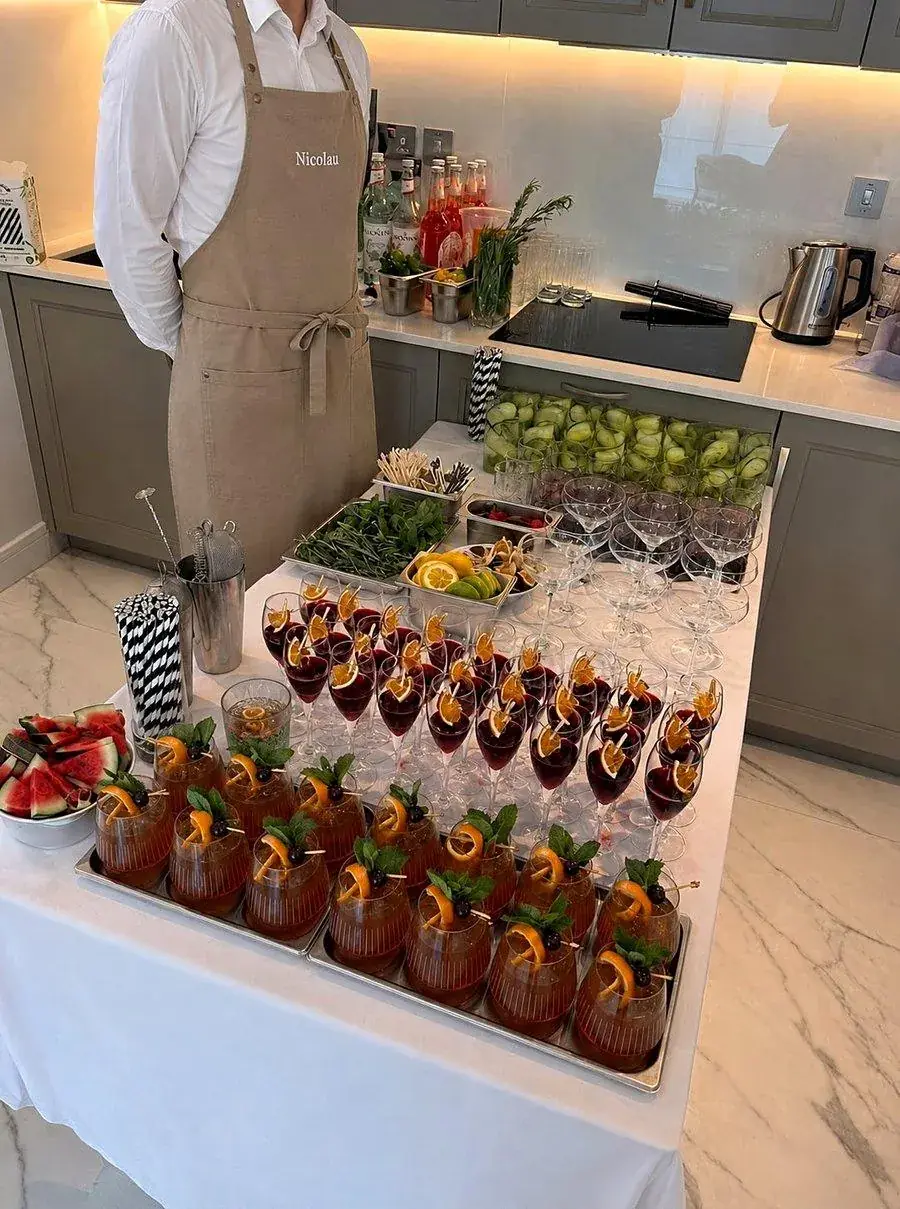
One of the most practical decisions in planning a private event's drinks is whether to run a fully open bar or a more limited, curated selection — and it's less about budget than most people assume.
01What an open bar means in practice
An open bar typically means guests can order freely from a full range of spirits, wine, and cocktails throughout the event, with no restrictions on quantity or specific drinks — the most flexible option for guests, and the one that requires the most planning to run smoothly.
02What a limited or curated bar looks like
A limited bar offers a focused selection — perhaps three or four signature cocktails, a curated wine list, and beer — giving guests genuine choice without the complexity (and cost unpredictability) of a fully open bar.
03Why curated often works better, not just cheaper
A focused bar menu, thoughtfully designed, often creates a better guest experience than an overwhelming open bar — service moves faster, the drinks are more considered, and guests aren't stuck choosing from an intimidating list.

04When an open bar makes more sense
For events where flexibility matters more than curation — a long corporate reception with varied guest preferences, for example — an open bar can be the right call, provided it's staffed appropriately for the guest count.
05A hybrid approach
Many private events land somewhere in between: a curated cocktail and wine list that covers most preferences, with a short list of full-bar spirits available on request for guests who want something specific. This is often the most practical setup for a bespoke bar service.
See the full service page: Private Bartender & Cocktail Bar Hire →
06Managing Guest Expectations Either Way
Whichever format you choose, clear (if subtle) signage or guidance for guests — a printed menu at a curated bar, or simply confident staff who know the full range available at an open bar — makes a real difference to how smoothly the evening runs. Guests unsure of what's available tend to hover and ask more questions, slowing service regardless of which format you've chosen, so a little thought toward communication goes a long way.
07Revisiting the Decision for Multi-Part Events
For an event with distinct phases — drinks reception, dinner, later dancing — it's worth considering a different bar approach for each phase, rather than assuming one format has to apply uniformly across the whole evening.
08Choosing What's Right for You
There's no universally correct answer here — the right choice depends entirely on your guests, your venue, and what kind of evening you're hoping to create.
09Considering How This Affects Your Overall Budget Planning
An open bar carries more cost uncertainty than a curated bar with a fixed scope, which is worth factoring into your overall event budget planning. A limited bar, by contrast, gives you a predictable cost from the outset — useful if you're managing a fixed overall event budget.
10A Final Practical Tip
Whichever format you choose, briefing your bar team clearly on the agreed approach in advance avoids any confusion or inconsistency in how drinks are served once the event is underway.
11Deciding based on your guests
Consider who is attending, how long the event lasts and how much your guests are likely to drink. A seated dinner with wine and one signature cocktail often needs less than a standing reception where drinks are the main activity. Think also about the service staff available, since a broader menu needs more bartenders to avoid queues. A well-chosen limited menu with good ingredients and fast service can feel more generous than an open bar that is slow to pour.
Not sure which bar format suits your event? Talk it through via the enquiry form and get a straightforward recommendation.
Plan Your BarFurther reading: The Spirits Business: event bar trends
Explore: all cuisine styles.