
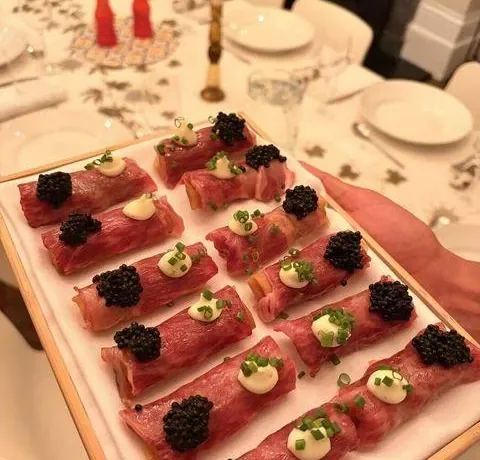
What is wagyu beef? It is beef from Japanese cattle breeds, prized for fine marbling that melts at a low temperature and gives an exceptionally tender, rich flavour. Grades such as A5 describe yield and quality, with the highest marbling scores found in Japanese wagyu. Because it is so rich, serve small portions of around 80 to 120 grams and cook it briefly over high heat.
Alejandro Nicolau, a London private chef trained under Martin Berasategui, and his team cook wagyu in canapés, tasting menus and plated dinners. This guide explains what the labels mean, how to choose a cut and how a chef cooks it so it tastes as it should.
01What is wagyu beef?
Wagyu is a Japanese term: wa means Japanese and gyu means cow. It refers to several breeds, of which Japanese Black is the most common, and is known for the intramuscular fat that runs through the muscle in fine lines, called marbling.
That fat has a lower melting point than the fat in most beef, so it softens as it cooks, giving the meat its characteristic buttery texture and a savoury, almost sweet flavour.
02What does A5 wagyu mean?
In Japan, beef is graded on two things: yield grade (A, B or C) and quality grade (1 to 5). A5 means the highest yield grade and the highest quality grade, which takes into account marbling, colour, texture and the quality of the fat.
- Yield grade: how much usable meat the carcass produces.
- Quality grade: marbling, meat colour, firmness and fat quality.
- Marbling score: on a scale of 1 to 12 where the higher numbers show the finest marbling.
The grading applies to Japanese beef. Wagyu reared elsewhere, including in the UK, may be full-blood or cross-bred and graded differently, so ask your supplier what is being sold.
03Which cuts work best?
- Sirloin and striploin: a classic for slicing and searing.
- Ribeye: richly marbled and full of flavour.
- Fillet: lean and tender, with a delicate texture.
- Rump and cap: good value for thin slices, tartare and canapés.
- Brisket and short rib: suitable for slow cooking and braising.
The cut, the marbling and the way you plan to serve it should decide what you buy, not the label alone.
04How much wagyu do you need per person?
Because wagyu is so rich, smaller portions are better. As a guide, plan around 80 to 120 grams per person for a main course of A5, and 150 to 200 grams for lower-marbled cuts. As a canapé or tasting course, 20 to 40 grams is often enough.
Pair it with something fresh and acidic, such as pickles, a light sauce or a simple salad, so the richness does not overwhelm the palate.
05How do you cook wagyu?
- Bring it to room temperature for 20 to 30 minutes before cooking.
- Season simply with sea salt just before it goes into the pan.
- Use a very hot, dry pan and cook it for a short time, since the fat will render without added oil.
- Rest it for a few minutes so the juices settle.
- Slice it thinly against the grain and serve immediately.
For lower-marbled wagyu, cook it as you would a fine steak, to your preferred doneness. A5 should be treated with restraint: its richness is the point, and overcooking wastes it.
06How is wagyu used in a menu?
A chef will rarely serve a large wagyu steak as the only dish, because its richness suits small, precise servings. It works best seared and sliced, served raw as tartare or carpaccio, or placed on a canapé or nigiri-style piece.
- As a canapé with caviar, a light cream or truffle.
- As a starter of thinly sliced seared beef with pickles.
- As a main served in a small portion alongside seasonal vegetables.
See how many canapés per person for planning quantities and wine and menu pairing for a private dinner to choose drinks that match.
07How do you buy wagyu well?
Because wagyu varies so much in grade and origin, the best approach is to buy from a specialist you trust and to ask a few direct questions.
- Where does it come from? Japan, the UK or elsewhere, and which breed.
- What is the grade? A5 for Japanese beef, or the producer's own marbling score.
- Is it full-blood or cross-bred? This affects marbling, flavour and how you cook it.
- How was it aged and stored? Freshness and handling matter for texture.
- How much do I need? Buy slightly less than you think, since portions are small.
A good supplier will answer these questions without hesitation.
08What should you serve alongside wagyu?
The richness of wagyu calls for contrast. Choose simple, fresh and acidic partners that cleanse the palate between bites.
- Pickled vegetables or a light citrus-based sauce.
- Steamed rice, charred leeks or a simple salad.
- A crisp, dry white wine, a sparkling wine or a light red with good acidity.
- A small salt, such as flaky sea salt, rather than a heavy sauce.
Keep the plate uncluttered. One excellent ingredient served well is the whole idea.
09Is wagyu worth it?
For a special occasion, a small portion of well-sourced wagyu can be the most memorable course of the evening. The key is to buy from a supplier you trust, to know what you are buying and to serve it in a way that lets it shine rather than serving a large amount.
A private chef can source it, plan the portions and cook it at the right moment. See sample menus and intimate dinners, then use the enquiry form for a tailored proposal within 24 hours.
Planning an event and want the food and drinks taken care of? Send the date, guest count and any requirements through the enquiry form and the team will reply within 24 hours.
Plan Your EventExplore: sample menus, intimate dinners, canapé catering.